skip to content
 

Introduction and overview

Heads of Institutions that receive income from the sale of goods or services, including Research, must establish procedures to ensure that all sales are authorised and supplied as agreed. All relevant risks to the University must be considered and managed and are made only to acceptable credit risks3 .
The procedures and considerations detailed in this section are designed to ensure best practice in relation to:

  • the terms and conditions applicable for the goods and/or services to be provided
  • whether to extend credit to external customers (debtors)

The procedures followed at the pre-sales stage of the trading process are essential for managing the financial, legal and reputation risks associated with trading activities. This section explains the pre-sales procedures to be followed. This needs to be considered in the context of the size, nature, and frequency of the transaction(s).

On this page:


Pre-Sales Procedure

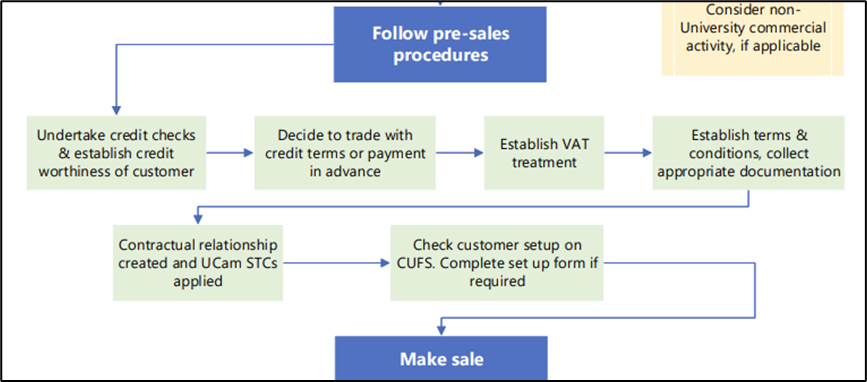
The following steps summarise the procedures institutions must follow before the supply of goods and services is made.

  1. Evaluate whether the proposed trading activity is appropriate for the University 
  2. Assess of the creditworthiness of potential and existing customers
  3. Consider the particular credit risks associated with this activity
  4. Establish the correct VAT treatment
  5. Ensure appropriate terms and conditions of sales are used and issued to the customer
  6. Provide a quote for customer, if appropriate
  7. Ensure appropriate documentation e.g., purchase order, has been received from the prospective customer
  8. Check customer record is setup in UFS

Back to top


Trading without credit terms

Where using standard credit terms is not applicable, payment in advance is the recommended option.

Payment in advance is to be used:

  • if after assessing the credit worthiness of the customer, the decision is not to extend credit
  • if the fulfilment of the supply requires the incurring by the University of external costs or the purchase of substantial amounts of materials or components
  • if the supply requires a substantial commitment of time and resources within the University prior to delivery which cannot be recovered if the customer subsequently defaults
  • if there is no satisfactory past trading with the customer or if the customer does not have a positive credit rating
  • if the goods in question cannot readily be recovered and resold e.g., events such as conferences, seminars, courses, and room hire. Non-payment should result in non-attendance/access
  • for overseas customers where it is difficult to sue for payment

Charging a deposit: where full payment in advance is not appropriate, requesting a deposit from the customer at the time of accepting order is an effective way to limit future debt and may be combined with further stage payments.

Staged payments: For long-term courses of high value or production of a specific piece of equipment over a length of time, billing may be staged over a set period.

Back to top


Bank guarantee

Normally used for the sale of goods and should be considered for UK sales over £10,000, and for non-UK sales over £5,000. The guarantee can stipulate specific terms and conditions.

A bank guarantee may be requested if there is a risk of non-settlement, or if the sale involves the shipment of goods that require customer checks and approval before payment.

Under a bank guarantee, if the customer (the buyer) is unable to make the payment to us (the seller), then the bank would pay the fixed amount to us if the customer does not meet the obligations under our contract.

Back to top


Determining the correct VAT treatment

Prior to any sale being made, institutions must establish whether VAT needs to be charged for the supply of good or service to this specific customer.

To ensure the correct tax treatment is used for a sale, the following information must be ascertained.

  • What is the item being sold?
  • What is the association to the University’s core business? (Refer to Considerations Before External Sales are Made)
  • What is the status of the of external customer:
  • Is the customer located outside the UK?
  • Are they a registered charity?
  • Is the customer VAT registered and if so, what is their VAT number?
  • Has the customer provided a VAT exemption/relief form for this sale?
  • What is the delivery address for the goods or services?
See FPM Chapter 9: VAT & Other Taxes for detailed guidance

 If in doubt of the correct VAT treatment, the Tax Team will be able to assist with specific queries. For sales outside the UK, refer to the Import/Export Hub for the latest information.

Back to top


Appropriate payment methods

In addition to payment terms, it is important for institutions to establish in advance the most appropriate payment method. The customer can be billed, by raising an invoice, or the item could be added to the University’s online store. If an invoice is to be issued, consideration should be given to the way customers will settle the invoice.

Certain methods of payment incur charges which will need to be accounted for in the price. In some cases, the customer may require additional information to be included on the invoice in order to settle promptly (e.g., the customer’s purchase order number).

Approved methods of payment are:

NB: Payment by cash or cheque is discouraged.

The University holds bank accounts for both US Dollars (USD) and Euro currencies and therefore payments can be made directly into the relevant accounts. If you have agreed that the customer will be settling in either USD or Euros, then raise the invoice in the corresponding currency using the corporate rate as shown in UFS.

Although exchange rates for several foreign currencies are pre-loaded into UFS at the start of each month, this is to facilitate payments made to foreign Accounts Payable Suppliers. It should not be seen as authorisation to raise Accounts Receivable transactions in foreign currencies.

Refer to the Cash and Banking Procedures, FPM Chapter 7, for full details of the procedures to follow when receiving particular types of payments, as well as guidance on secure storage.

Back to top


Quotations

Where a prospective customer has requested a quotation (or it is considered appropriate to issue one), use the template from the Finance Division web page. The issue of a quote and its subsequent acceptance by the customer guarantees the application of the University’s STC.

Each quotation must be given a sequential reference number, prefixed with the institution code. Quotations that are not accepted must be retained for three years, and those accepted for six years, as they form part of the University’s business records. The University STC should be attached to the quotation and forwarded to the prospective customer, or the customer provided with a web link to the STC on the Finance Division page.

The quoted prices must be exclusive of VAT or any other taxes unless stated otherwise. It should be made clear that the price quoted includes handling, freight, packaging, insurance, and any other similar costs which might be applicable. If, as part of the supply to the customer, goods are ordered for delivery outside the UK, we are responsible for import duties, whatever they may be at the time of delivery or release to the customer.

Quotations are valid for 90 days unless a different period is specified on the quote itself.7

Back to top


Customer purchase orders

Goods and/or services must not be provided on credit without a customer purchase order or the appropriate written equivalent contract. A customer purchase order provides written confirmation of the customer’s details (e.g., current address, contact details) and must be referenced on the invoice raised. Many organisations will not process payments without such documentation and may cause settlement to be unnecessarily delayed.

This is particularly important when arrangements may be informal, such as sponsorship. Formal written orders avoid problems at a later stage. 

Purchase orders usually include reference to the customer’s standard terms and conditions. Therefore, it is essential the customer’s purchase order is accepted in writing to make it clear that the University’s STC will apply.

As many customers use a supplier portal (also known as a vendor portal), a PO number is essential to upload the resulting invoice. Refer to Making Sales, Supplier Portal to register on a customer’s portal.

Back to top


Customer accounts on UFS

To create an invoice, the customer must exist in UFS. The Credit Control Team provides a centralised service to set up and amend customers in Accounts Receivable. This service is designed to reduce the administrative burden on the institutions, avoid duplications and ensure consistency.

Searching for customers in UFS

Once the decision to trade has been made, check if the customer already exists in CUFS. For guidance, refer to AR Searching for customers. If a customer exists on CUFS, every institution can see and use the customer. If the customer does not exist or the customer details are incorrect, refer to the Adding and amending UFS customers section below.

Adding and amending UFS customers

You must ensure you provide the full legal name, address, and contact details of the customer. You need to be able to properly identify your debtor if at a later stage you wish to take legal action on an outstanding debt. Institutions are responsible for alerting the Credit Control team of any changes needed to the customer record.
The process is as follows:

  • Complete the AR Customer Set Up/Amendment Form available from the Forms webpage ensuring you have made entries in all mandatory fields.
  • Email the form, as an attachment, to the AR customer mailbox

Requests will be turned around within 3 working days. If appropriate, credit checks will be carried out as outlined in the pre-sales procedures.

Back to top


3 Financial Regulations 2012, Income and Expenditure, section 12.1

7  Clause 2.1 & 2.2 of the University’s Standard Terms & Conditions

Latest version 16 April 2024

Raven Login

Some items on this website are restricted. University members are encouraged to log in using Raven to make the best use of the site:
Login with Raven